
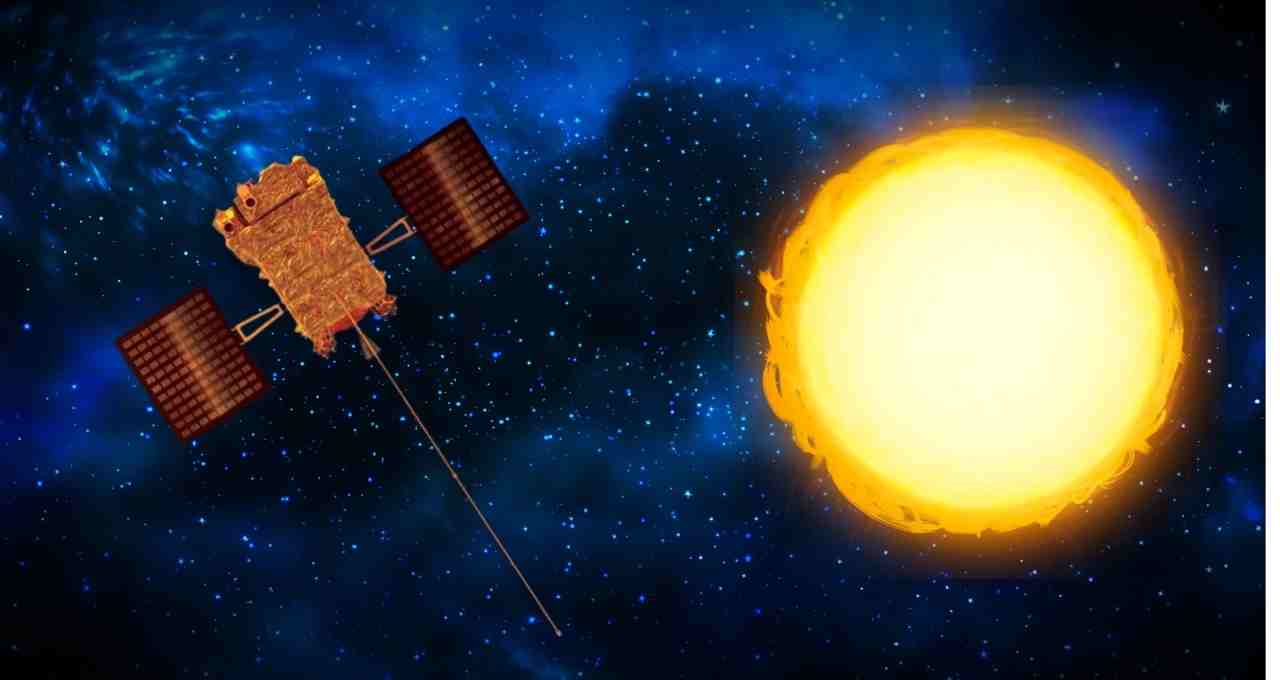
Aditya L1 is India’s first solar mission. It is a spacecraft that will be placed in a halo orbit around the Sun-Earth Lagrange point L1, which is about 1.5 million kilometers from Earth. This orbit will allow the spacecraft to have a continuous view of the Sun, without any eclipses.
Aditya L1 will carry seven scientific payloads:
- Visible Emission Line Coronagraph (VELC): To study the corona, the Sun’s outer atmosphere.
- Solar Ultraviolet Imaging Telescope (SUIT): To study the Sun’s chromosphere and transition region.
- Solar X-ray Spectrometer (SoLEXS): To study the Sun’s corona and flares.
- Helium-10S Imaging Spectrometer (HEL10S): To study the Sun’s chromosphere and transition region.
- Aditya Solar Plasma Experiment (ASPEX): To study the Sun’s solar wind.
- Plasma Analyzer Package for Aditya (PAPA): To study the Sun’s solar wind.
- Advanced Tri-axial High-Resolution Digital Magnetometers: To study the Sun’s magnetic field.
Objectives
The main objectives of the Aditya L1 mission are to:
- Study the Sun’s corona and its dynamics.
- Understand the coronal heating mechanism.
- Study the solar wind and its acceleration.
- Study the Sun’s magnetic field and its role in solar eruptions.
- Study the Sun-Earth space environment.
Launch Date and Budget
Aditya L1 is scheduled to be launched in September 2023. The budget for the mission is estimated to be around 400 crore rupees (US$53 million).
Benefits
The Aditya L1 mission is expected to provide a number of benefits, including:
- A better understanding of the Sun’s corona and its dynamics, which will help us to better understand space weather.
- A better understanding of the coronal heating mechanism, which is one of the most fundamental unsolved problems in solar physics.
- A better understanding of the solar wind and its acceleration, which will help us to better protect our satellites and astronauts from the harmful effects of solar radiation.
- A better understanding of the Sun’s magnetic field and its role in solar eruptions, which will help us to better predict solar storms and their impact on Earth.
- A better understanding of the Sun-Earth space environment, which will help us to develop better technologies to protect our infrastructure from space weather.
Conclusion
The Aditya L1 mission is a significant milestone in India’s space program. It is the country’s first solar mission and is expected to provide a number of important scientific benefits. The mission is also a source of national pride for India, demonstrating the country’s growing space capabilities.
